
Installing a gazebo can completely transform your outdoor living space — but the secret to a gazebo that looks great and lasts for decades isn’t just in the installation. It’s in the preparation that comes before it.
Many homeowners focus entirely on choosing the right gazebo style, material, or size, only to discover later that a poorly prepared backyard leads to costly problems: a tilting structure, pooling water after every rainstorm, a foundation that shifts with the freeze-thaw cycles common in Ontario winters, or a gazebo that simply doesn’t fit the way they imagined.
In this guide, we walk you through every critical preparation step — from choosing the ideal location in your Toronto-area backyard to evaluating soil conditions, selecting the right foundation, planning drainage, and understanding local permit requirements. Follow these steps and your gazebo installation will be smoother, safer, and built to last.
Why Proper Backyard Preparation Matters
Skipping preparation steps might save time in the short run, but it almost always creates bigger problems down the line. Here’s why getting the groundwork right makes all the difference.
Improves Structural Stability
A gazebo is only as stable as the ground beneath it. If the foundation isn’t level, or if the soil is too loose or prone to shifting, the entire structure can rack, warp, or sink over time. Proper ground preparation — including leveling, compacting soil, and choosing the right foundation type — ensures the gazebo stays plumb and secure for years.
Prevents Water Damage
Water is one of the most destructive forces for outdoor structures. Without proper drainage planning, rainwater and snowmelt can pool around the base of your gazebo, seeping into the foundation and rotting wooden components or corroding metal anchor hardware. Thoughtful site preparation diverts water away before it ever becomes a problem.
Extends Gazebo Lifespan
A gazebo installed on a well-prepared site can last 20 to 30 years or more with routine maintenance. One installed on an unprepared site may begin showing structural issues within just a few years. The time invested in preparation directly translates to the longevity of your investment.
Reduces Installation Costs
Preparing your backyard properly upfront reduces surprises during installation. Discovering unstable soil, hidden utility lines, or drainage issues mid-project can halt work and add significant unexpected costs. A thorough assessment before work begins keeps your project on schedule and on budget.
Choose the Right Location for Your Gazebo
Location is one of the most impactful decisions you’ll make. A gazebo placed in the wrong spot can be uncomfortable to use, difficult to access, or structurally compromised. Take the time to evaluate your backyard from multiple angles before committing.
Consider Sun Exposure
Think about how you’ll use the gazebo most — morning coffee, afternoon entertaining, or evening relaxation. A site with morning sun and afternoon shade is ideal for most Toronto-area homeowners. Avoid placing your gazebo directly under large deciduous trees that will drop leaves and debris onto the roof, causing moisture buildup and staining.
Think About Privacy
Your gazebo should feel like a retreat. Position it to take advantage of existing natural privacy screens like hedges, fences, or mature trees. In densely built Toronto neighbourhoods, consider how the location will look from neighbouring yards and whether you’ll want to add trellises or plantings for additional screening.
Check Accessibility
Your gazebo should connect naturally to your home and yard. Ideally, it should be accessible from a patio door or back door without requiring a long walk across the lawn. A clear, safe pathway from the house to the gazebo — whether a flagstone path, poured concrete, or interlocking brick — will encourage year-round use and add to the overall design.
Avoid Low-Lying Areas
In Ontario backyards, low-lying areas collect water during heavy rain and spring snowmelt. Installing a gazebo in a depression or at the bottom of a slope creates chronic drainage issues that are very difficult to correct after the fact. Always choose the highest, most naturally well-drained area of your yard, or plan significant grading work if your options are limited.
Consider Future Landscaping Plans
Think beyond today. If you’re planning to add a pool, vegetable garden, or expanded deck in the next few years, factor that into your gazebo placement. Relocating a gazebo — especially one on a concrete slab — is extremely difficult and expensive. Plan for the yard you want, not just the yard you have.
Toronto-Specific Tip: Many Toronto backyards are long and narrow, often 25 to 40 feet wide. For these layouts, placing the gazebo at the far end of the yard creates a natural destination and maximizes usable entertaining space closer to the house. If your backyard is on a ravine lot — common in areas like Don Mills, Scarborough, or the Humber Valley — pay close attention to grading regulations and potential erosion issues before finalizing your location.
Measure and Mark the Installation Area
Once you’ve chosen a general location, it’s time to get precise. Accurate measurements prevent costly errors and ensure the finished installation looks intentional and professional.
Measuring Available Space: Start by measuring the total open area available. Don’t just measure for the gazebo footprint — account for overhanging roof eaves, which typically extend 12 to 24 inches beyond the base frame on each side.
Required Clearance Around the Gazebo: Leave a minimum of 2 to 3 feet of clear space around the entire perimeter of the gazebo. This allows for comfortable movement, lawn maintenance, and air circulation that helps prevent moisture buildup on the structure.
Walkways and Access Routes: Map out where the entry points to the gazebo will be and ensure adequate walkway width — a minimum of 36 inches for comfortable single-file passage, 48 inches or more for pairs.
Nearby Trees and Obstacles: Note the location of mature trees, garden beds, fences, and utility boxes. Tree roots can interfere with foundations and will continue to grow after installation. Overhead branches may pose a hazard in ice storms or high winds — both common Ontario weather events.
Pre-Installation Measurement Checklist
- Measure the full gazebo footprint including roof overhang
- Confirm at least 2–3 ft clearance on all sides
- Identify and mark any underground utilities (Call Before You Dig: 1-800-400-2255 in Ontario)
- Note tree root zones within 10 ft of the installation site
- Mark proposed walkway routes
- Measure distance from property lines
- Confirm measurements against local setback requirements
- Stake and string the area to visualize the footprint on-site
Evaluate Ground Conditions
No foundation performs well on compromised ground. Before choosing a foundation type, you need to understand what you’re working with.
Level Ground Requirements
The installation area should be as close to level as possible. A variance of more than 1 to 2 inches across the gazebo footprint will require grading or additional foundation work. Use a long level, a laser level, or hire a surveyor for large installations.
Soil Stability
Different soils behave very differently under load and through seasonal freeze-thaw cycles. Sandy soils drain well but may shift. Clay-heavy soils — extremely common across the Toronto area and much of Southern Ontario — expand when wet and contract when dry, creating movement that can crack slabs or shift patio stone foundations over time. A simple hand-penetration test (pushing a rod 12 inches into the ground with minimal resistance) can reveal whether soil is adequately compact.
Drainage Assessment
Walk your yard after a heavy rain. Areas that stay wet for more than 24 to 48 hours have poor natural drainage. If your proposed gazebo site falls in one of these zones, you’ll need to address drainage actively — either through grading, adding a gravel sub-base, or installing a French drain system — before laying any foundation.
Identifying Potential Issues
Common Ontario soil issues to watch for include:
- High clay content — causes heaving and cracking in winter
- Fill soil — unstable, requires compaction or removal
- Organic soil layers — decompose over time, causing settlement
- High water table — particularly relevant near rivers, ravines, or lakefronts in the GTA
- Rock ledge near surface — may require specialized anchoring
Choose the Best Foundation for Your Gazebo
The foundation is the most critical structural element of your gazebo. The right choice depends on your site conditions, budget, climate, and gazebo type.
Concrete Slab
A poured concrete slab is the most permanent and structurally sound foundation option.
Pros: Extremely stable, low long-term maintenance, ideal for large or heavy hardtop gazebos, provides a clean finished surface, performs well through Ontario winters when properly reinforced and poured below the frost line.
Cons: Highest upfront cost requires professional installation for best results, permanent (difficult to remove or relocate), requires proper forming and curing time before installation can proceed.
Patio Stone Base
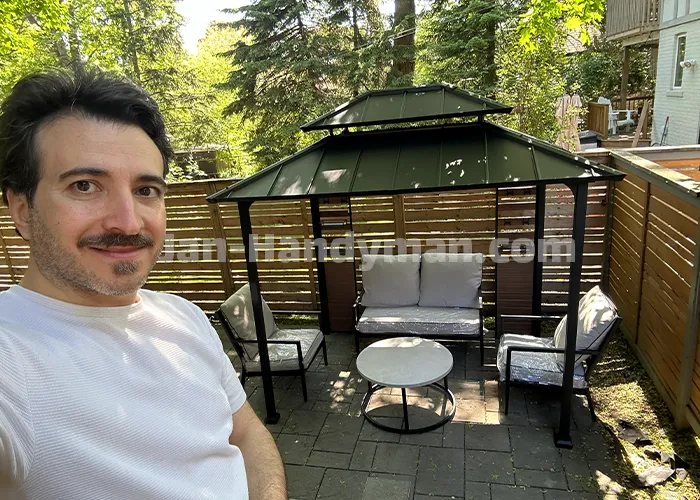
A base of interlocking patio stones or flagstone set on compacted gravel is a popular mid-range option.
Pros: More affordable than concrete, DIY-friendly, attractive appearance, relatively easy to adjust or modify, good drainage when properly installed.
Cons: Can shift over time — especially in clay-heavy Ontario soil — requires periodic releveling, not ideal for large or very heavy gazebo structures.
Gravel Foundation
A compacted gravel bed provides a simple, permeable base.
Pros: Excellent drainage, very affordable, easy to install, good for smaller or temporary gazebo structures.
Cons: Not suitable for hardtop or permanent gazebos, requires edging to prevent migration, can be uncomfortable underfoot without additional surfacing, less aesthetically polished.
Deck Installation
Mounting a gazebo to an existing or new wooden or composite deck integrates the structure into your overall outdoor living space.
Pros: Maximizes usable outdoor space, creates a unified design, allows for elevated installation on uneven terrain, can incorporate built-in seating and storage.
Cons: The deck must be structurally engineered to support the gazebo’s load and wind forces, requires professional assessment, may trigger additional permitting requirements, deck material must be properly maintained to protect the gazebo structure.
Foundation Comparison Table
|
Foundation Type |
Cost | Durability | DIY Friendly | Best For |
|---|---|---|---|---|
|
Concrete Slab |
$$$ |
Excellent |
No |
Large hardtop gazebos, permanent structures |
|
Patio Stone |
$$ |
Good |
Yes |
Medium gazebos, decorative installations |
|
Gravel Base |
$ |
Fair |
Yes |
Small or temporary structures |
| Deck Mount | $$–$$$ | Excellent | Partial |
Sloped yards, integrated deck spaces |
Plan for Proper Drainage
Even with a solid foundation, poor drainage can undermine your gazebo installation over time. Water management is a long-term investment in your structure’s health.
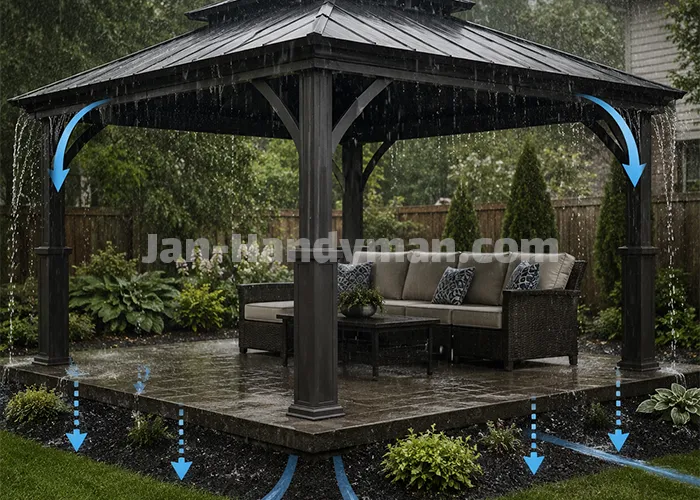
Water Runoff: The ground around your gazebo should slope gently away from the structure — a grade of approximately 1 inch per foot for the first 6 feet is a common guideline. This ensures that rainwater and snowmelt run away from the foundation rather than pooling at the base.
Slope Considerations: If your backyard naturally slopes toward the house, your gazebo site may require grading to redirect water flow. This is best addressed before foundation work begins, not after.
French Drains: For sites with persistently poor drainage, a French drain — a gravel-filled trench with a perforated pipe that redirects subsurface water — can be installed around the perimeter of the foundation. This is particularly valuable in Ontario’s clay-heavy soils, where surface water moves slowly and subsurface saturation is common.
Avoiding Standing Water: Standing water under or around a gazebo accelerates rot in wood components, corrodes metal fasteners and anchors, creates a habitat for mosquitoes, and in winter, freezes and expands — damaging foundations and structural connections.
Long-term maintenance is far easier when drainage is handled proactively. A well-drained site means fewer repairs, longer-lasting finishes, and a more enjoyable outdoor space in every season.
Check Local Regulations and Permits
Before any ground is broken, it’s essential to understand the regulatory landscape. Requirements vary by municipality, and non-compliance can result in fines or orders to remove an unpermitted structure.
Toronto Permit Considerations: In the City of Toronto, gazebos may be classified as accessory structures. Permit requirements depend on factors including the size of the structure, whether it has a permanent foundation, and whether electrical work is involved. As of current Toronto Building Code guidelines, structures over a certain square footage or with permanent foundations typically require a building permit — but requirements can change, so always verify directly with the City of Toronto’s Building Division.
Property Line Setbacks: Toronto zoning bylaws require minimum setback distances between accessory structures and property lines. These vary by zoning class and lot size. Placing a gazebo too close to a property line without approval can result in required modifications or removal.
HOA Requirements: If your property is within a condominium corporation or a neighbourhood with a homeowners’ association, additional approval may be required before installation. Review your declaration and rules and submit any required applications well in advance of your planned installation date.
Utility Line Checks: Before any digging, contact Ontario One Call (1-800-400-2255) to have underground utilities located and marked. This is a free service and a legal requirement in Ontario. Gas lines, electrical conduit, water mains, and telecommunications cables are all commonly found in residential backyards.
Note: This section provides general informational context only. Always verify current requirements directly with the City of Toronto, your local municipality, and qualified professionals before beginning any construction work.
Prepare Utilities Before Installation
One of the most common regrets among gazebo owners is not planning for utilities during installation. Running electrical conduit or irrigation lines after the gazebo is built is significantly more difficult and expensive.
Lighting: Overhead lighting makes a gazebo usable after dark and dramatically increases its ambiance. If you’re considering any hardwired lighting — recessed ceiling fixtures, chandelier-style pendants, or soffit lighting — electrical conduit should be run before the foundation is poured or the platform is built.
Ceiling Fans: A ceiling fan in a gazebo is one of the most effective ways to extend comfortable outdoor use through Toronto’s warm, humid summers. Like lighting, ceiling fans require hardwired electrical and should be planned at the foundation stage.
Outdoor Outlets: A weatherproof exterior outlet within the gazebo opens up a world of possibilities — from outdoor speakers and string lights to blenders and phone chargers. One or two outlets installed during construction costs a fraction of what a retrofit would.
Speakers: For a seamless audio experience, consider conduit for speaker wiring or outdoor-rated Bluetooth speaker mounting points integrated into the structure.
Heating Systems: Propane or natural gas patio heaters, infrared heaters, or even outdoor fireplaces extend the Toronto gazebo season well into autumn. If a gas line is a possibility, now is the time to plan the routing.
Planning utilities early doesn’t mean committing to every feature immediately. Running empty conduit during installation is inexpensive and gives you the flexibility to add features later without significant disruption.
Common Backyard Preparation Mistakes
Even well-intentioned homeowners make preparation errors that cost time and money. Here are the most frequent mistakes — and how to avoid them.
Choosing the Wrong Location
Selecting a gazebo site based purely on aesthetics, without considering sun exposure, drainage, access, or future landscaping plans, is the most common mistake. Take the time to observe your yard across different times of day and in different weather conditions before committing.
Ignoring Drainage
Drainage problems that seem minor before installation often become serious after the gazebo is in place. Once the structure is built, correcting drainage issues beneath or around it becomes significantly more complex. Always address drainage at the site evaluation stage.
Skipping Ground Leveling
Assuming the ground is “close enough” to level without measuring is a risky shortcut. Even small discrepancies can become major structural issues over time, causing doors to bind, rooflines to rack, and fasteners to loosen prematurely.
Underestimating Space Requirements
Many homeowners measure the gazebo footprint and nothing else. When the structure is installed with roof overhangs and surrounding clearance requirements accounted for, the footprint is often 4 to 6 feet larger in every direction than expected. Always measure the full assembly, not just the base frame.
Not Planning Utilities
Retrofitting electrical, gas, or irrigation after installation is one of the most avoidable and regrettable mistakes. The cost difference between planning during installation versus adding utilities later can be substantial — often several times more expensive for the same result.
When to Hire a Professional Gazebo Installer
While smaller, freestanding gazebos on level ground may be within the reach of a confident DIYer, many installations genuinely benefit from — or require — professional expertise.
Consider engaging professional gazebo installation services when:
- You’re installing a large hardtop gazebo. Hardtop aluminum or steel gazebos are heavier, more complex to assemble, and require precise foundation work to perform safely.
- Your terrain is uneven or sloped. Grading, leveling, and building a foundation on a slope requires experience and often specialized equipment.
- A permanent foundation is required. Poured concrete work, frost-depth footings, and engineered deck structures should be handled by qualified tradespeople.
- Utility work is involved. Any hardwired electrical, gas line connection, or irrigation requires licensed professionals and inspections.
- You’re navigating permit requirements. A professional installer familiar with Toronto and GTA regulations can help manage permit applications and ensure the installation meets all code requirements.
The cost of professional installation is almost always offset by the quality of the result, the reduction in errors, and the warranty coverage that reputable installers provide.
Backyard Preparation Checklist
Use this comprehensive checklist to confirm you’ve covered every preparation step before installation day.
Location Selection
- Evaluated sun exposure throughout the day
- Confirmed adequate privacy or planned screening
- Verified clear access route from the house
- Avoided low-lying or poorly draining areas
- Considered future landscaping and yard changes
Measurement and Layout
- Measured full footprint including roof overhangs
- Confirmed minimum 2–3 ft perimeter clearance
- Marked and staked the installation area
- Identified and documented all nearby trees and obstacles
- Confirmed distance from property lines
Ground and Soil Assessment
- Measured ground level across the full footprint
- Assessed soil type and stability
- Observed drainage after rainfall
- Identified any potential soil issues (clay, fill, organics)
Foundation Planning
- Selected appropriate foundation type for site conditions
- Obtained quotes from qualified contractors if required
- Confirmed foundation depth meets local frost requirements
Drainage Planning
- Confirmed ground slopes away from structure
- Planned French drain or grading work if needed
- Identified and resolved any standing water areas
Permits and Regulations
- Confirmed permit requirements with City of Toronto or local municipality
- Verified property line setback compliance
- Checked HOA or condo corporation requirements (if applicable)
- Called Ontario One Call to mark underground utilities
Utilities Preparation
- Decided on desired utility features (lighting, fans, outlets, heating)
- Planned conduit routing before foundation work
- Engaged licensed electrician or gas fitter if required
Professional Consultation
- Determined whether professional installation is required
- Obtained quotes from qualified gazebo installers
- Confirmed installer experience with Toronto-area projects and permit requirements
A well-prepared backyard doesn’t just make installation easier — it sets the foundation for a gazebo you’ll enjoy for decades. Take the time to do it right, and the results will speak for themselves.